
The world looks different upside down. That, in many ways, is the entire point.
Of all the postures in yoga, none reorganize the practitioner's relationship to the world quite like inversions. To turn the body upside down — even briefly — is to disrupt every familiar reference point. Blood shifts. Balance resets. The floor becomes the ceiling of your attention. It is disorienting by design, and that disorientation is precisely where the practice begins.
At the summit of this family of postures sits Shirshasana, or Headstand — often called the "king of asanas" for the totality of what it demands and offers. Let's explore what it teaches, how to approach it with care, and which other inversions belong on the path to trying a new perspective.
What Is Shirshasana (Headstand)?
Shirshasana comes from the Sanskrit Shirsha, meaning head, and Asana, meaning pose. In its full expression, the crown of the head rests on the mat, the forearms form a stable base, and the legs extend straight up toward the sky — the body inverted, weight distributed carefully between the arms and head.
The title "king of asanas" is not given lightly. Headstand asks for strength through the shoulders and core, precision in alignment, and — perhaps most importantly — a willingness to relinquish the certainty of an upright world. In the yogic tradition, inversions are believed to reverse the usual pull of gravity on the circulatory and lymphatic systems, and to quiet the mind by disrupting its most habitual orientation. Whatever the exact mechanism, students consistently describe the same experience: a headstand rearranges more than blood flow. It rearranges attention.
How to Practice Shirshasana
Note: Headstand carries real risk to the neck and cervical spine. It is best learned first with the guidance of an experienced teacher, and is not recommended during pregnancy, with neck or back injuries, high blood pressure, or glaucoma.
Begin kneeling, forearms on the mat, fingers interlaced, elbows shoulder-width apart.
Place the crown of the head on the mat, cradled by the interlaced hands, with the back of the head pressing gently into the palms.
Lift the hips high, walking the feet in toward the head, similar to the setup for a forearm-supported downward dog.
Engage the shoulders and core before lifting the feet, pressing the forearms firmly into the mat to keep weight off the head as much as possible.
Lift the legs slowly, bringing the knees to the chest first, then extending upward only once balance feels secure.
Keep the gaze steady and the breath even, resisting the urge to hold the breath under the unfamiliar sensation.
Come down with control, reversing the entry, and rest in Child's Pose afterward to let the neck and nervous system settle.
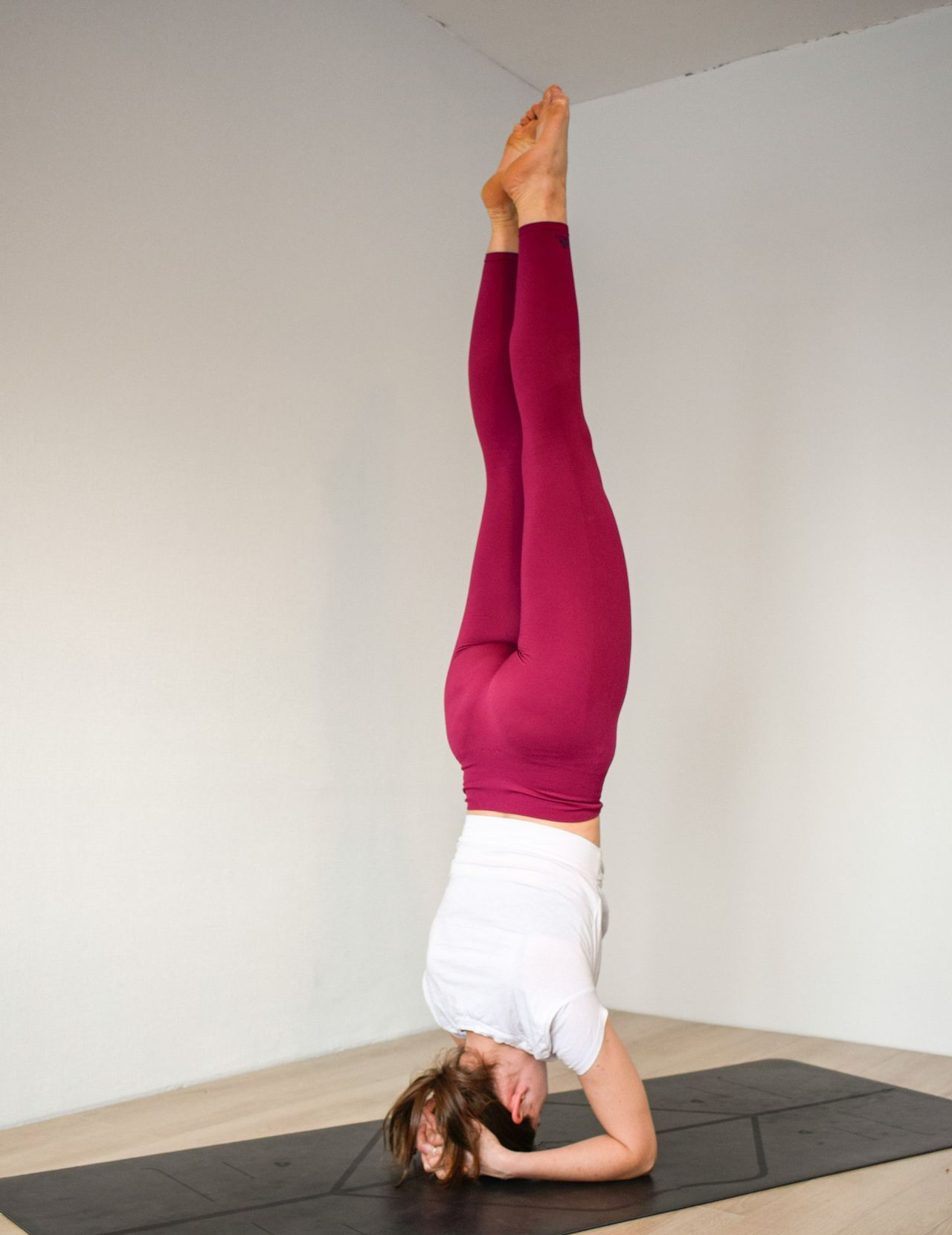
The instruction worth remembering: Headstand is held by the shoulders and core, not the neck. If most of the weight is resting on the head, the pose is not yet ready to be held — the foundation needs more strength first.
The Benefits of Shirshasana
Strengthens the shoulders, arms, and core, building the foundation required to support the body safely inverted.
Improves circulation, sending blood flow toward the brain and upper body in a way upright postures rarely do.
Calms the nervous system, often producing a distinct sense of stillness once the initial disorientation settles.
Builds focus and mental clarity, since successful practice requires full presence and steady breath.
Offers a literal shift in perspective, disrupting habitual patterns of thought simply by disrupting the body's habitual orientation.
Few postures make the connection between physical practice and mental state as immediate as Headstand. To see the room upside down, even for a few breaths, is to be reminded that most perspectives — physical and otherwise — are more changeable than they feel.
Common Mistakes to Avoid
Placing too much weight on the head and neck. The forearms and shoulders should carry the majority of the load.
Kicking up into the pose. A controlled, gradual lift protects the neck far better than momentum.
Rushing the learning process. Headstand rewards patience over years, not urgency in a single session.
Practicing without guidance early on. A teacher's eyes on alignment are invaluable while the foundation is still being built.
Beyond Headstand: Other Inversions Worth Exploring
Shirshasana sits at one end of a spectrum of inversions — several of which offer similar benefits with a gentler entry point, and some of which extend the practice even further.
Adho Mukha Svanasana (Downward-Facing Dog) A gentle, accessible inversion, Downward Dog offers many of the circulatory benefits of full inversions while remaining low-risk and widely practiced — a natural starting point for building comfort being upside down.
Sarvangasana (Shoulder Stand) Often practiced alongside Headstand, Shoulder Stand shifts the weight onto the shoulders rather than the head, offering a different — and for many, more accessible — path into full inversion.
Pincha Mayurasana (Forearm Stand) Building on the forearm foundation of Headstand, Forearm Stand removes the head from the equation entirely, demanding significant shoulder strength and balance.
Adho Mukha Vrksasana (Handstand) The most demanding inversion in this family, Handstand balances the entire body on the hands alone — a pose that draws on the strength, focus, and trust built through every inversion that comes before it.
The Deeper Lesson of the Inversion
In yogic philosophy, inversions are often described as postures of renewal — not because they reverse blood flow, though they do, but because they interrupt the mind's most automatic assumptions. The floor is not always the floor. The usual view is not always the only view. What feels destabilizing at first is often just unfamiliar, and what is unfamiliar tends to pass, given enough steady breath.
Shirshasana asks the practitioner to sit with that unfamiliarity rather than rush past it — to stay upside down long enough for it to stop feeling strange. This, more than any physical benefit, may be the pose's most lasting gift: proof that a new perspective, however disorienting at first, is something the body and mind can learn to hold.
Ready to move beyond the poses and into the deeper wisdom that shapes them? Explore the Beyond Asana course and take the next step in your practice.