
Some poses ask you to stand tall. Others ask you to leave the ground entirely — and trust your own two hands to hold you there.
Arm balances occupy a strange, thrilling corner of yoga practice. Unlike standing poses, which draw strength up from the earth, arm balances reverse the relationship entirely — the hands become the foundation, the feet lift free, and the body finds itself suspended between effort and trust. It is no surprise that these postures often bring out a very particular mix of determination and nervous laughter in students first attempting them.
At the center of this practice sits Bakasana, or Crow Pose — often the first arm balance a student attempts, and one of the most instructive. Let's look at what it teaches, how to practice it safely, and which other arm balances belong on the path to holding on with strength.
What Is Bakasana (Crow Pose)?
Bakasana comes from the Sanskrit Baka, meaning crow, and Asana, meaning pose. In this shape, the hands press firmly into the mat, the knees rest against the upper arms, and the feet lift off the ground as the body balances forward over the hands — compact, alert, and perched, much like the bird for which it's named.
Crow Pose is often mistaken for a test of arm strength alone. In truth, it is a test of something closer to trust. The arms provide the foundation, but it is the willingness to shift weight forward — past the point where falling feels possible — that actually lifts the feet from the floor. Many students can hold the necessary strength in their arms long before they can summon the nerve to lean into it.
In the yogic tradition, arm balances are considered postures of courage and focus, requiring the practitioner to meet fear directly rather than around it. To practice Bakasana is to practice trusting your own foundation, built breath by breath, rather than waiting for fear to disappear before beginning.
How to Practice Bakasana
Begin in a low squat, feet close together, hands planted firmly on the mat shoulder-width apart.
Bend the elbows slightly, creating a shelf with the upper arms for the knees to rest against.
Place the knees high on the upper arms, close to the armpits, rather than low near the elbows.
Shift the weight forward onto the hands, spreading the fingers wide for a stable base.
Lift one foot at a time, or both together, bringing the toes to hover just above the mat.
Draw the gaze slightly forward, rather than down, to help shift the weight in the right direction.
Hold for a few breaths, then lower with control, returning to the low squat.
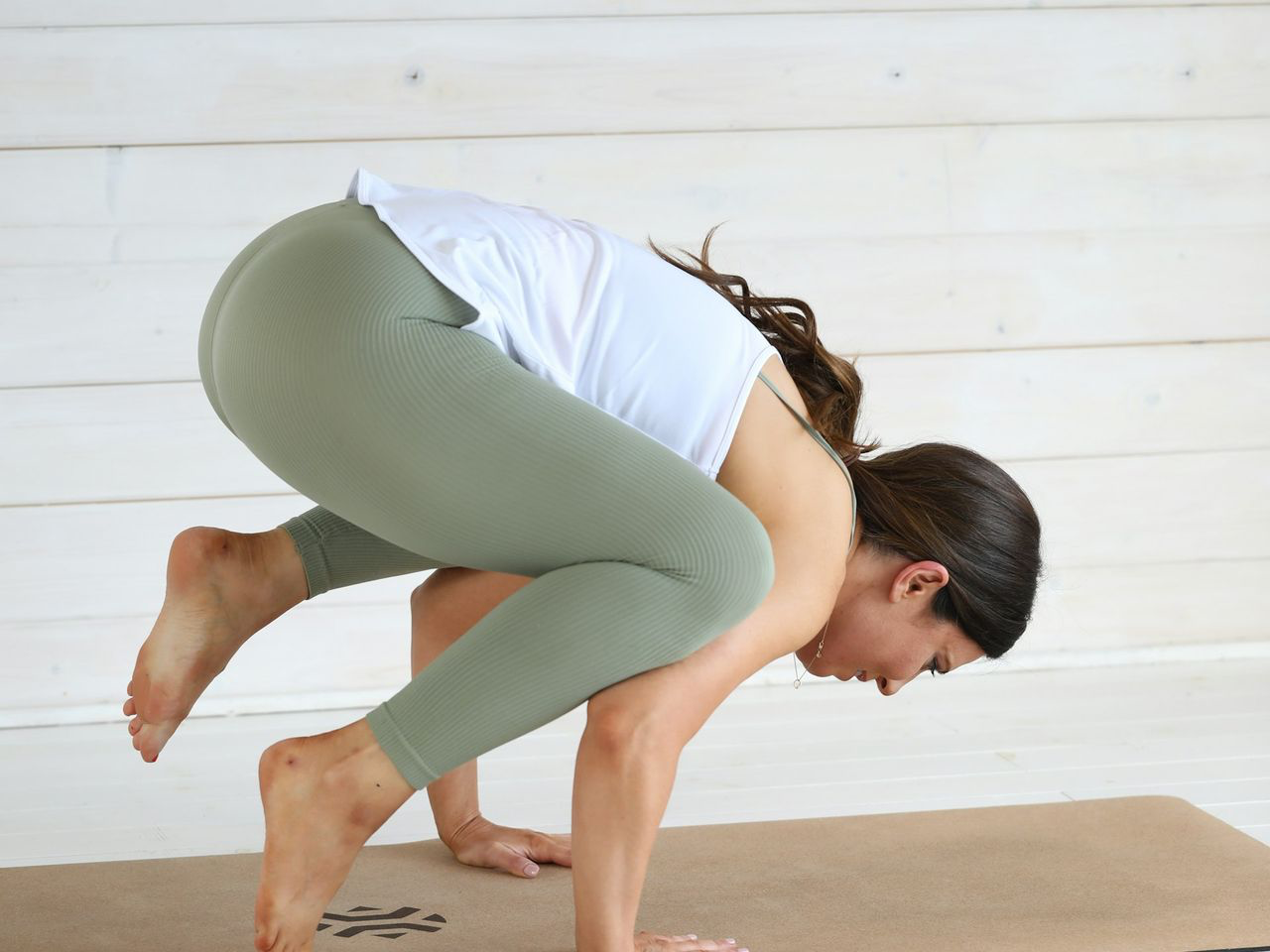
The instruction worth remembering: Crow Pose lifts through commitment to the forward shift, not through strength alone. Many falls happen not from a lack of strength, but from a hesitation to lean far enough forward to let the feet rise.
The Benefits of Bakasana
Strengthens the wrists, arms, and shoulders, building the foundation for more advanced arm balances.
Engages the core deeply, since the abdominal muscles are what keep the body compact and lifted.
Improves focus and mental steadiness, as the pose demands full attention to remain balanced.
Builds confidence and courage, given the pose's reputation as an early, meaningful edge for most practitioners.
Teaches the value of commitment over hesitation, a lesson that rarely stays confined to the mat.
Crow Pose is often the posture where students discover that strength was never really the missing piece. What changes the outcome, more often than not, is the willingness to trust a foundation already built.
Common Mistakes to Avoid
Placing the knees too low on the arms. Aim for high up, near the armpits, for better leverage.
Looking down at the mat. This shifts the weight backward — keep the gaze slightly ahead instead.
Hesitating at the tipping point. A brief, committed shift forward will lift the feet more effectively than a slow, uncertain one.
Forgetting to engage the core. A disengaged midsection makes the pose far heavier on the arms than it needs to be.
Beyond Crow Pose: Other Arm Balances Worth Exploring
Once Bakasana feels familiar, a wider practice of arm balances opens — each posture building on the same foundation of strength, focus, and trust.
Parsva Bakasana (Side Crow Pose) Adding a twist to the foundational shape, Side Crow challenges balance and core strength from a rotated position, building on the stability first developed in Bakasana.
Astavakrasana (Eight-Angle Pose) A more complex arm balance involving a bind around one leg, this pose combines flexibility, strength, and focus in a single demanding shape.
Eka Pada Koundinyasana (Flying Pigeon Pose) Building directly on the shoulder strength and core engagement of Crow Pose, this posture adds a deep hip opener into the mix, extending one leg long behind the body.
Tittibhasana (Firefly Pose) An advanced pose that combines hamstring flexibility with arm strength, Firefly Pose extends both legs forward while balancing entirely on the hands — a natural progression for practitioners ready to build past Bakasana.
The Deeper Lesson of the Arm Balance
In yogic philosophy, the practice of balancing on the hands is often spoken of as a practice in meeting fear directly — not by waiting for it to pass, but by building enough strength and focus to move through it anyway. Arm balances rarely feel entirely safe the first time. That discomfort is not a sign to stop. It is the shape the practice takes.
Bakasana asks the practitioner to lean forward before feeling fully ready — to trust hands that have already been trained, even when the mind has not yet caught up. This is, perhaps, the truest transfer the pose offers beyond the mat: strength alone rarely moves you forward. It is the willingness to commit to the lean that does.
Ready to move beyond the poses and into the deeper wisdom that shapes them? Explore the Beyond Asana course and take the next step in your practice.