
Not every posture is meant to build something. Some are meant to let something go.
Where backbends open and arm balances demand, forward folds ask for something altogether quieter: surrender. The spine rounds, the gaze drops, the outside world briefly disappears from view. It is no accident that forward folds are often placed toward the end of a yoga sequence, or that they are so reliably the poses students least want to skip. In a nervous system pulled in a dozen directions by daily life, forward folds offer something rare — an unmistakable, physical signal to soften.
At the center of this family of postures sits Paschimottanasana, or Seated Forward Fold — one of the most complete and quietly powerful ways to calm an overstimulated system. Let's look at what it teaches, how to practice it patiently, and which other forward folds belong on the path to calming your nervous system.
What Is Paschimottanasana (Seated Forward Fold)?
Paschimottanasana comes from the Sanskrit Paschima, meaning west or the back of the body, Uttana, meaning intense stretch, and Asana, meaning pose. Seated with the legs extended forward, the practitioner folds from the hips over the length of the legs, stretching the entire back body — the origin of the name, since in traditional yoga orientation, facing east in meditation, the back of the body faces west.
Beyond the deep hamstring and spinal stretch, Paschimottanasana is classified in the yogic tradition as a calming, introspective posture. Folding forward is thought to stimulate the parasympathetic nervous system — the body's rest-and-digest response — in direct contrast to the more activating effect of backbends and inversions. The physical shape of the pose, drawing the body inward and the gaze down, mirrors exactly the internal shift it is designed to support.
How to Practice Paschimottanasana
Sit on the mat with the legs extended straight ahead, using a folded blanket under the hips if the lower back rounds easily.
Flex the feet gently, pressing through the heels without locking the knees.
Inhale and lengthen the spine, reaching the arms overhead to create length before folding.
Hinge forward from the hips, leading with the chest rather than the head, keeping the spine as long as possible.
Hold wherever the fold naturally stops — the shins, ankles, or feet — without forcing further reach.
Relax the shoulders and neck, letting the head hang heavy rather than straining toward the feet.
Hold for 5–10 breaths or longer, allowing each exhale to soften slightly deeper into the fold.
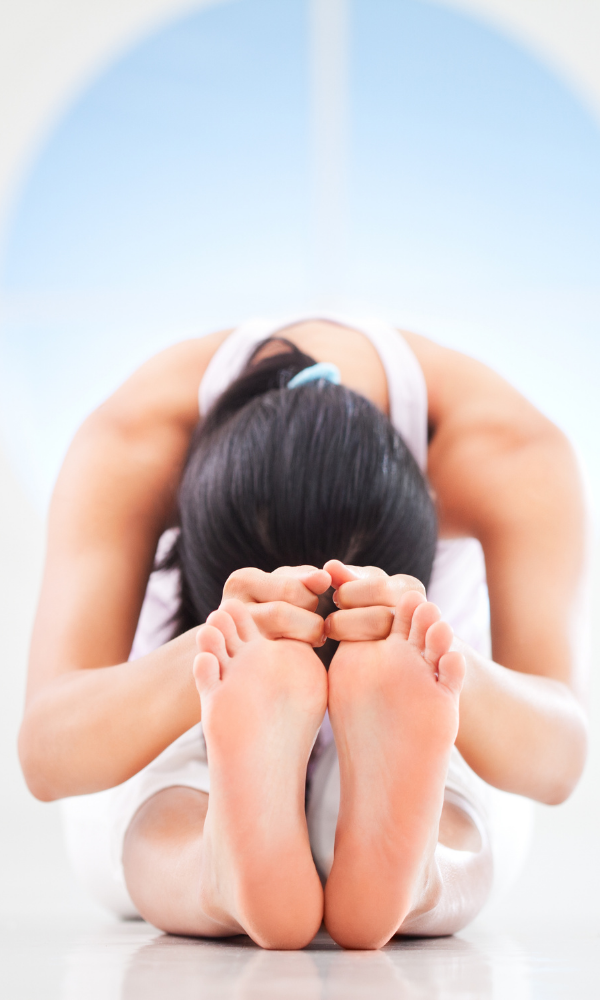
The instruction worth remembering: Paschimottanasana is a pose of release, not achievement. A shorter fold with a long spine and a relaxed breath will always calm the nervous system more effectively than a deeper one built on tension.
The Benefits of Paschimottanasana
Stretches the hamstrings, lower back, and spine, releasing tension accumulated from prolonged sitting.
Activates the parasympathetic nervous system, encouraging a measurable shift toward calm.
Lowers heart rate and blood pressure, particularly when held for longer, meditative durations.
Supports digestion, as the gentle compression of the fold is believed to stimulate the abdominal organs.
Quiets mental activity, offering a physical cue for the mind to turn inward and settle.
Forward folds like this one work with the body's own signals rather than against them. The instinct to curl inward when overwhelmed is a natural one — Paschimottanasana simply gives it a deliberate, supported shape.
Common Mistakes to Avoid
Rounding the spine excessively to reach further. Length in the spine matters more than depth in the fold.
Forcing the head toward the knees. Let the head hang naturally rather than straining the neck forward.
Bouncing into the stretch. A held, steady fold releases tension far more effectively than repeated bouncing.
Holding the breath. Since the pose is meant to calm the system, breath should stay slow and unforced throughout.
Beyond Seated Forward Fold: Other Forward Folds Worth Exploring
Once Paschimottanasana feels familiar, a wider practice of forward folds opens — each one offering a similar invitation to soften, in a slightly different shape.
- Uttanasana (Standing Forward Fold): A standing variation of the same surrender, Uttanasana folds the body forward from standing, offering an accessible reset between more active postures.
- Balasana (Child's Pose): Often used as a resting shape throughout a practice, Child's Pose folds the body forward from a kneeling position, offering one of the most immediately calming shapes in yoga.
- Janu Sirsasana (Head-to-Knee Pose): Folding over one extended leg at a time, this posture combines the hamstring release of Paschimottanasana with a gentle spinal twist, useful for addressing asymmetries between the two sides of the body.
- Upavistha Konasana (Wide-Angle Seated Forward Fold): Extending the legs wide before folding forward, this variation adds an inner-thigh stretch to the calming effects of the seated fold.
The Deeper Lesson of the Forward Fold
In yogic philosophy, forward folds are often associated with introspection — a literal and figurative turning away from the external world and toward the internal one. Where backbends and inversions ask the practitioner to meet the world with an open chest or a new vantage point, forward folds ask for the opposite: a quiet withdrawal, a softening of effort, a willingness to simply be still.
Paschimottanasana offers this not as avoidance, but as necessary balance. A nervous system that is only ever activated, without a reliable way to downshift, tends toward exhaustion rather than resilience. The fold provides that downshift directly — not through force, but through the simple, repeated choice to soften a little further with each breath.
To fold forward, in this sense, is to practice something the mind often resists but the body already knows: rest is not the absence of progress. It is often what makes the next effort possible.
Ready to move beyond the poses and into the deeper wisdom that shapes them? Explore the Beyond Asana course and take the next step in your practice.