
Every posture in yoga eventually asks the same quiet question: what is holding you up from the inside?
It is tempting to think of strength as something visible — the lifted chest of a backbend, the rooted stance of a warrior. But much of the strength that makes those postures possible lives somewhere far less visible: the deep muscles of the abdomen, the low back, the hips — the center from which nearly every other movement is born. Yoga has a name for the practice of building this strength directly, and it comes, fittingly, in the shape of a small, steady vessel.
Navasana, or Boat Pose, is the clearest expression of this work — a posture with no props, no momentum, and nowhere to hide. Let's explore what it teaches, how to practice it with integrity, and which other core strength poses belong at the center of a resilient practice.
What Is Navasana (Boat Pose)?
Navasana comes from the Sanskrit Nava, meaning boat, and Asana, meaning pose. Balanced on the sit bones, the body forms the shape of a "V" — legs lifted, torso lifted, arms extended forward like oars — resembling a small boat afloat on still water.
There is something instructive in that image. A boat stays upright not because it is rigid, but because its weight is balanced around a stable center. Navasana asks the same of the body. The pose cannot be forced through the arms or legs; it can only be held by engaging the deep core muscles that keep the torso lifted and steady.
In the yogic tradition, the core is often associated with the manipura chakra — the seat of personal will, discipline, and inner fire. To strengthen this center is to strengthen far more than the muscles of the abdomen. It is to build the physical foundation for steadiness of purpose.
How to Practice Navasana
Sit on the mat with knees bent, feet flat on the floor, hands lightly gripping behind the thighs.
Lift the chest and lengthen the spine before leaning back, keeping the back flat rather than rounded.
Lean back slightly, finding the point of balance on the sit bones, just behind the tailbone.
Lift the feet off the floor, bringing the shins parallel to the ground for a first stage of the pose.
Extend the arms forward, parallel to the shins, palms facing inward.
If it feels available, straighten the legs to a 45-degree angle, keeping the chest lifted and the spine long.
Hold for 3–5 breaths, then release with control rather than collapsing out of the shape.
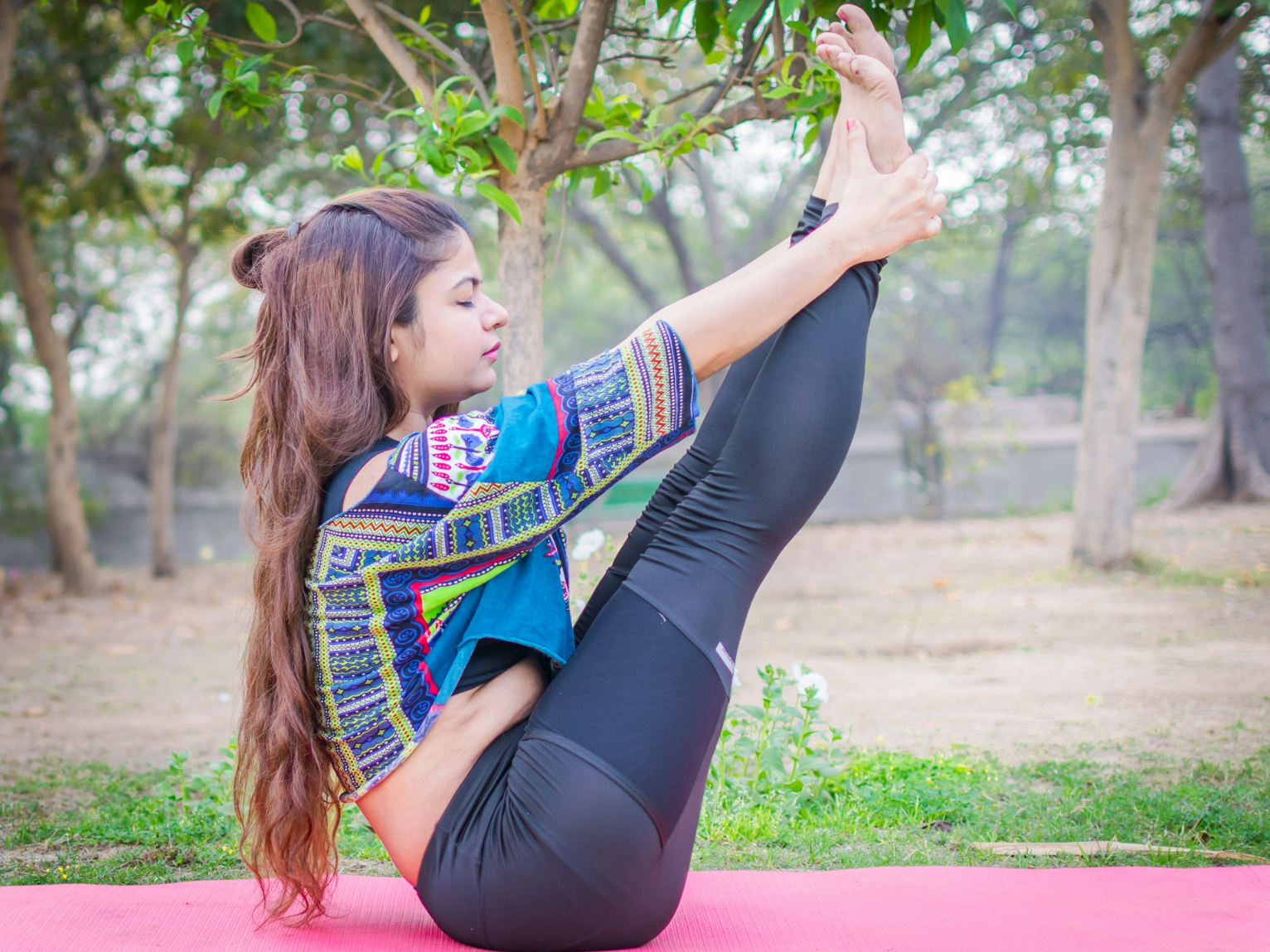
The instruction worth remembering: Boat Pose is held by the length of the spine, not the strength of the arms or the height of the legs. A shorter hold with a long, engaged back will always serve the body better than a taller one built on a rounded spine.
The Benefits of Navasana
Strengthens the deep core muscles, including the rectus abdominis, obliques, and hip flexors.
Improves balance and coordination, since the pose requires constant micro-adjustments to stay steady.
Supports spinal health, as a strong core reduces strain on the lower back in daily movement.
Builds mental focus and discipline, given the sustained effort the pose demands with no external support.
Encourages steadiness under challenge, training the body — and mind — to hold form even when effort intensifies.
Few poses reveal the connection between physical and mental effort as directly as Navasana. The shake that often appears in the final breaths of the hold is not a sign of failure — it is the sign of exactly the strength being built.
Common Mistakes to Avoid
Rounding the spine. Keep the chest lifted throughout; a rounded back shifts effort away from the core and into the lower back.
Straining the neck. Keep the gaze slightly forward and the neck relaxed, rather than jutting the chin.
Holding the breath. A held breath tightens the body against itself — steady breathing supports the hold instead.
Chasing full extension too soon. Keeping the knees bent with shins parallel to the floor is a complete pose, not a lesser one.
Beyond Boat Pose: Other Core Strength Poses Worth Exploring
Once Navasana feels steady, a wider practice of core strength opens — each posture building the same deep stability in a different shape.
Phalakasana (Plank Pose) A foundational strength-builder in its own right, Plank Pose engages the core alongside the shoulders and legs, building the full-body integration that supports poses like Navasana.
Ardha Navasana (Half Boat Pose) A lower-intensity variation with the shoulders and feet hovering closer to the ground, this pose offers a sustainable way to build endurance in the same muscles.
Vasisthasana (Side Plank Pose) Shifting the challenge to one side of the body at a time, Side Plank builds core strength alongside shoulder stability and balance.
Paripurna Navasana to Ubhaya Padangusthasana (Boat to Both Big Toes Pose) A more advanced expression, this transition adds a forward reach for the toes while maintaining the balance and lift of the original pose — a natural next step once Navasana feels secure.
The Deeper Lesson of Core Strength
In yogic philosophy, the center of the body is often considered the seat from which all other action originates. A body that moves from a weak, disconnected core compensates elsewhere — the shoulders round, the lower back strains, the breath shortens under effort. A body that moves from a strong, engaged core does not need to compensate. It simply holds.
Navasana asks the practitioner to build that center honestly, without the help of momentum or props. There is nothing to hide behind in the pose — only the choice, breath by breath, to stay lifted.
This is, in many ways, the truest reflection the pose offers off the mat as well. The core of you is rarely the part that others see first. But it is the part that determines whether everything else stays standing.
Ready to move beyond the poses and into the deeper wisdom that shapes them? Explore the Beyond Asana course and take the next step in your practice.